And…What to Look For in June!
HWA Treatment Update
- In April and May, we treated over 100 Eastern Hemlock trees for Hemlock Woolly Adelgid (HWA).
- A majority of these trees were treated proactively. Once established, HWA spreads very quickly. These invader bugs reproduce asexually, so it takes only one female to produce hundreds of evil HWA babies. Whether infested or not, treated trees are protected for 5-7 years!
- A BIG THANK YOU to Craneridge neighbor Matt Gregory who volunteered two full days supporting forester and HWA expert, Joshua Konovitz.
- Each tree’s diameter was measured, and a metal ID tag was attached. Imidacloprid, was applied to the bark at the base of the tree. Each tree is tracked in a master spreadsheet, so we know when and where treatment occurred.
- Trees over 9 inches in diameter were prioritized for treatment. Dense Hemlock areas, especially along Tarn Trail, received attention. An area at the north end of Ridge, where some of Craneridge’s largest Hemlocks live, was also treated.
- Known infested trees were also targeted. Based on what we continue to see, we are in the early days of HWA infestation. However, we did find additional infestations during treatment.
Future Treatment Goals
- Our goal is to treat at least 150 Hemlocks in 2024.
- Treatment will continue in the fall. Cooler seasons are ideal treatment times.
- Additional Hemlocks will be treated over several years until a permanent bio-control (predator insects) is established in our area. And of course, we’ll continue to monitor.
What to Look For in June… and a Note of Caution
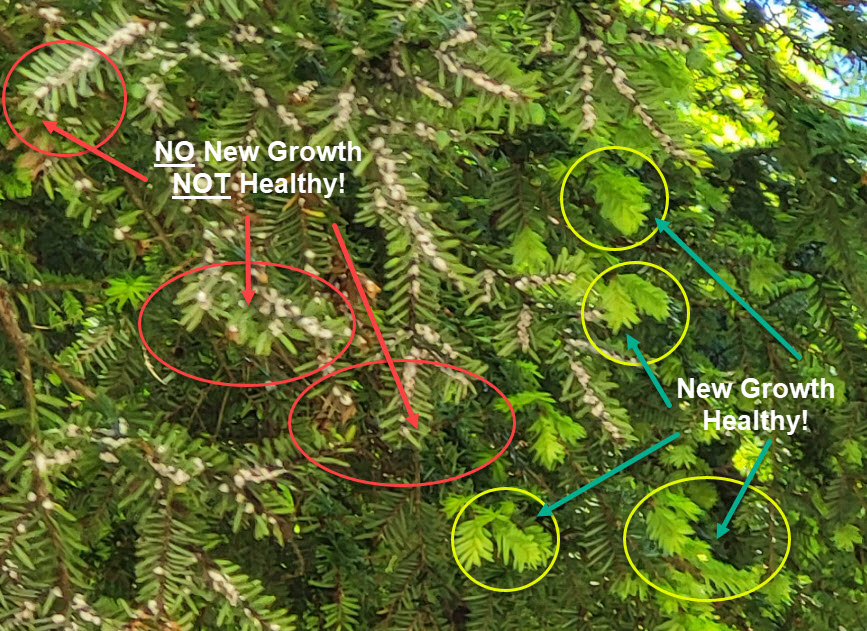
Now through June, healthy Hemlock branches have bright lime green, new growth tips. This time of year, the new growth is very visible!
HWA infested branches do not have this new growth. The image below is from the same Hemlock tree. The picture was taken from an infested tree along Tarn Trail.
What You Can Do!
- Look for branches that have previous years’ needles but no new bright green tips.
- If these branches also have white fuzzy balls (like mini Q-Tips), this is a sign of HWA.
- Ignore dead branches with no needles. Dead branches have not been impacted by HWA and their demise was caused by other impacts.
- If you have concerns about any Hemlock branches or trees, contact Gwen at gwenalegre@gmail.com or Sam at Slewandowski92@gmail.com. We’ll stop by to confirm HWA infestation and mark your tree for treatment for either this fall or next spring.
A Word of Caution!
Hemlock Woolly Adelgid, which are very tiny and hard to see, are currently in their active “crawler” stage (they do not fly). If you suspect an HWA infestation, avoid touching the branches. And don’t go hugging other Hemlocks!
If you have any questions or need HWA identification help, please contact either Gwen or Sam at the emails listed above! 😊
Want to Learn More About HWA?
If you love Craneridge and our Hemlocks, you’ll want to spend some time exploring this page. https://craneridge.org/take-a-stand-against-hemlock-woolly-adelgid/
 Craneridge Homeowners Association
You must be logged in to post a comment.